
What Went Wrong, An Honest Account of the 2024 Bearcat Motorsports FSAE Frame
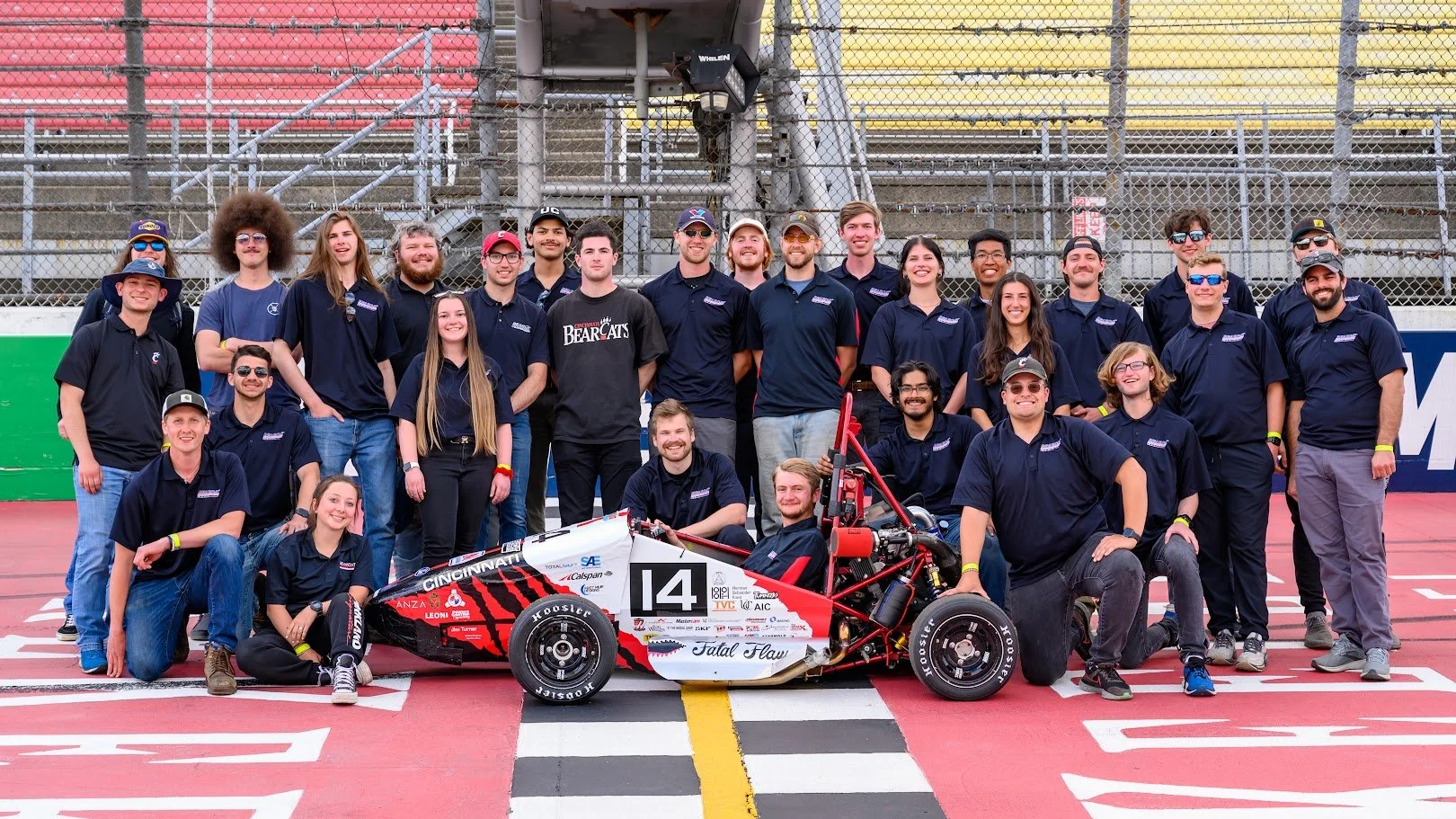
The 2024 Bearcat Motorsports IC frame achieved 0.5% correlation between simulation and physical torsion testing, a first torsional mode prediction within 4.7%, and suspension pickup points located to a machined jig specification. By the metrics we set at the start of the project, it was a successful build.
It also had failures worth documenting precisely, not as a disclaimer on the results, but because the failure analysis is technically more instructive than the results themselves. What follows is drawn from the engineering manual I wrote for the teams that come after us, covering the specific decisions that didn't work and why.
Roll Hoop Fixture Design
The main and front roll hoops are the primary rollover protection structures of the car. They are also, for jig design purposes, among the most difficult components to fixture correctly, a large-diameter bent tube presents very little flat reference geometry, and its position in the jig establishes the datum from which most of the surrounding frame assembles.
The approach we used was to design waterjet-cut sheet metal plates that would attach to the main jig runners and cradle the hoops at their correct positions. The logic was straightforward: waterjet parts are fast, cheap, and accurate to the drawing. In practice, the design had three compounding problems.
Material stiffness. The plate thickness selected for the hoop supports was insufficient to resist deflection under the combined weight of the hoop tube and the lateral forces introduced during tacking. The supports flexed visibly, which meant the hoop was not sitting at its nominal position when welds were being placed. A proper stiffness calculation on the support geometry, treating the plate as a cantilevered beam under the applied load, would have flagged this before fabrication. It wasn't done.
Attachment method. The supports connected to the main jig runners via a slots-and-tabs interface. The tolerances on this interface were designed too loosely, the tabs had enough play in the slots that the supports could shift laterally before being fixed. The intended correction was to tack the supports to the runners after positioning, but this introduced a new problem: any positioning error present at the time of tacking became permanent. The adjustability of the fixture was eliminated at exactly the moment it was most needed.
Tube clamping. The clamps used to secure the hoop tubes within the supports were carried over from a prior year's jig. They were not sized to the 2024 hoop tube OD, which left enough clearance for the tube to slide axially even when the clamps were fully torqued. Axial position of the hoop affects the height of the rollover plane and the geometry of the hoop braces, both of which are rules-critical dimensions.
The compounded result was a fixture that was nominally adjustable, effectively fixed at an unverified position, and unable to constrain all six degrees of freedom of the tube it was meant to locate. The hoop ended up within acceptable tolerances, but the margin came from careful manual adjustment during tacking rather than from the fixture functioning as designed. Three separate attempts at improving this fixture across the build season produced incremental improvements, none of which fully resolved the core stiffness and constraint problem.
The correct approach is a thicker aluminum support, sized by calculation, not by what stock was available, with a more constrained attachment method to the runners and clamps matched to the actual tube OD. The main roll hoop in particular warrants a dedicated, stiffer fixture than the system used in 2024.
CAD File Architecture
The frame CAD was partitioned into three separate NX part files early in the design process, front section, cockpit, and rear section, based on the expectation that smaller files would be more manageable in a shared team environment. This decision created more overhead than it eliminated.
Working across three files means that any reference geometry used by more than one section, node locations, datum planes, hoop centerlines, either has to be duplicated across files or linked through wave geometry references that break when files move or are renamed. Clearance checks that should take a single assembly query instead require opening multiple files and mentally reconciling their coordinate systems. When the suspension team updated pickup point coordinates, the change had to be propagated manually to whichever file contained the affected geometry rather than updating from a single source of truth.
A single master part file for the stick frame geometry, with tube surface models referencing it, would have been lighter to manage in practice than the split architecture, despite being a larger individual file. Version control discipline and a clear file ownership structure matter more for CAD integrity in a team environment than file size.
Why I'm Writing This
There's a tendency in engineering portfolios to present results and omit the friction that produced them. That's a choice I've tried to actively resist in documenting this project, not out of modesty, but because an honest failure analysis is more technically useful than a polished highlight reel, both for the teams that come after us and for the clients I work with now.
The engineers whose work I've learned the most from are precise about what failed and why. Not vague about "areas for improvement", specific about which design decision produced which outcome, and what the correct decision would have been. That precision is what makes a lessons-learned document worth reading rather than worth filing.
That's the standard I hold my own work to at Leugers Design and Development. If you're developing a hardware product and want an engineer who documents the failures as carefully as the successes, reach out.
