
Why Our Simulation Was Right, How to Make Predictions You Can Trust
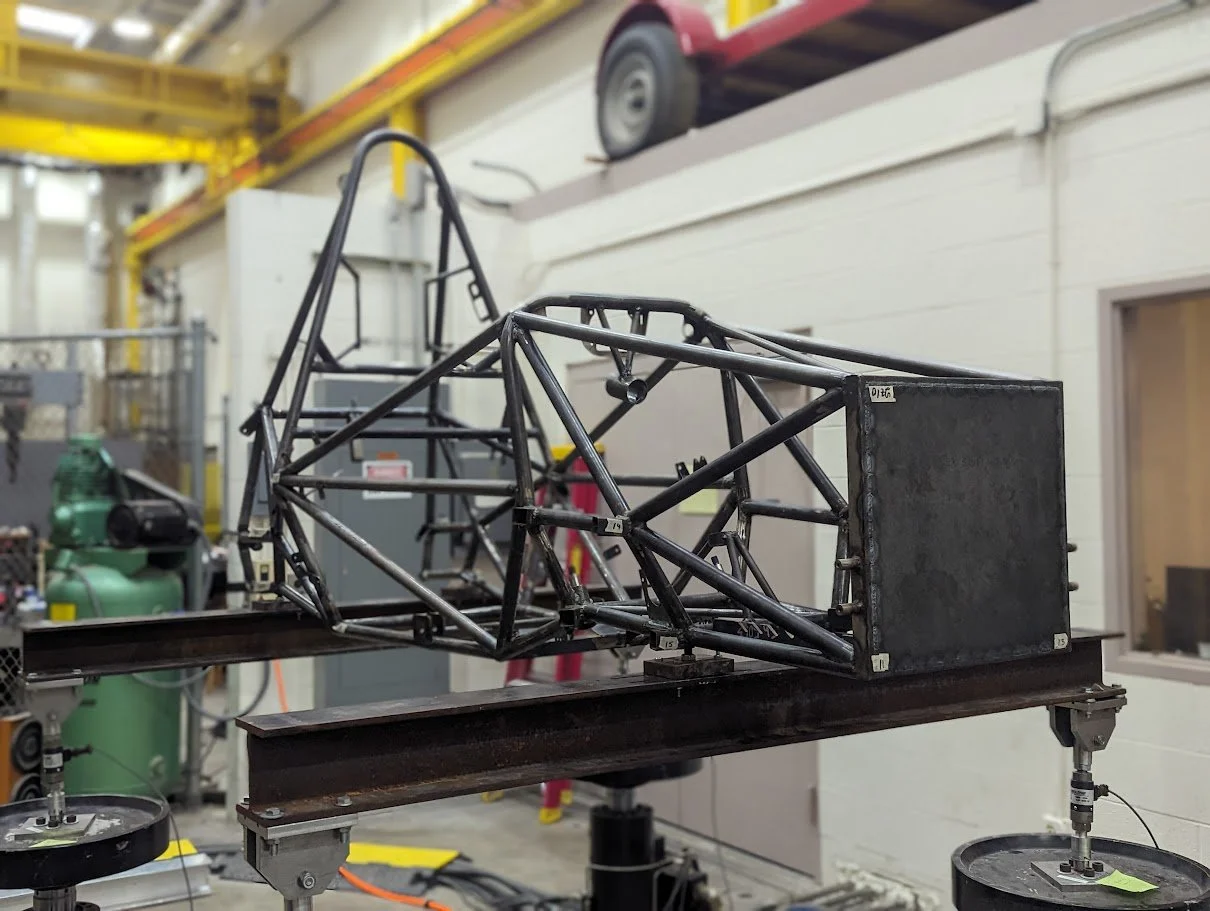
All models are wrong, some are useful. When the physical torsion test came back at 1,268 ft·lb/deg against a predicted 1,275 ft·lb/deg , 0.5% error, a few people on the team were surprised at how close it was. I wasn't. Not because I'm especially good at simulation, but because we had done the work beforehand to make the model earn that prediction.
A simulation result is only as trustworthy as the model that produced it. If you don't know how well your model represents reality, you don't actually know what it's telling you. Here's the process we used to close that gap , and why the sequencing of it matters.
The Problem With Trusting Textbook Numbers
Most simulation workflows go something like this: build a model, assign material properties from a textbook, run the analysis, trust the output, build the part, hope for the best.
The problem is that real welded steel structures don't behave exactly like textbook values suggest. Weld geometry, residual stresses from heating and cooling, and joint stiffness all introduce a gap between the model and the real thing. That gap might be small. It might be large. Without physical testing to compare against, you don't know which.
Our process ran in two stages specifically designed to measure and close that gap before making any performance predictions.
Stage One: Match the mass
Before touching any stiffness or frequency predictions, we tuned the material density in the simulation model until its calculated mass matched the physical frame's measured weight.
This sounds almost too simple to matter. It isn't. Natural frequencies, the rates at which a structure naturally vibrates, which tells you a lot about its performance, is a function of both stiffness and mass simultaneously. If your model's mass is wrong, every dynamic prediction it makes is wrong by a predictable but uncorrected amount. Getting the mass right first removes one variable before you start chasing the others.
Stage Two: Match the First Torsional Mode
With mass correct, we ran a modal test on the physical frame , essentially striking the frame with an instrumented hammer and measuring how it vibrates in response, at dozens of locations across the structure. The frame was hung upside down from bungee cords to match the unconstrained (free-floating) condition used in the simulation.
This test reveals the structure's natural frequencies and the shapes it deforms into at each frequency. The one we cared most about was the first torsional mode, the frequency at which the frame twists end-to-end. That came back at 80.3 Hz. The simulation predicted 84.13 Hz , a 4.7% error before any calibration.
We then adjusted Young's modulus (the material property that controls stiffness in the simulation) iteratively until the predicted frequency matched the measured value. Once mass and first torsional mode both match physical reality, the model is calibrated.
The static torsional stiffness prediction flows from the same calibrated model, which is why it came back at 0.5% rather than 5% or 15%.
Why the Sequence Matters
You might wonder why we bothered with the vibration test at all if the end goal was a quasistatic torsional stiffness test. Two reasons.
First, the vibration test is faster and cheaper to set up than a full torsion test. It gives you frequency and mode shape data that lets you check the model's geometry and material properties before you commit to the more involved physical setup that torsion testing requires.
Second, and more importantly, matching natural frequencies gives you confidence that the model is representing the structure's behavior correctly overall, not just that one output happens to agree. A model that predicts the right stiffness for the wrong reasons will fail you the moment you ask it a different question.
The loop runs in both directions: test data calibrates the model, and the calibrated model makes better predictions, which informs better design decisions before the next physical build.
What This Means for Your Project
If you've ever gotten a simulation result back and wondered whether to trust it, that uncertainty is the right instinct. Simulation is a tool, not an oracle. Its outputs are only as good as its inputs and assumptions.
The practical question for any hardware development project is: what physical data do you have to validate against? If the answer is none yet, the first prototype should be designed with that validation test planned from the start. "We'll simulate it, build it, and test it to see if it works" is one loop. "We'll simulate it, build a validation test, use that test to calibrate the model, then use the calibrated model to predict performance before final build" is a tighter, cheaper loop.
Simulation without a validation plan is expensive guesswork with better graphics. The methodology isn't complicated, but it has to be intentional from the beginning.
